
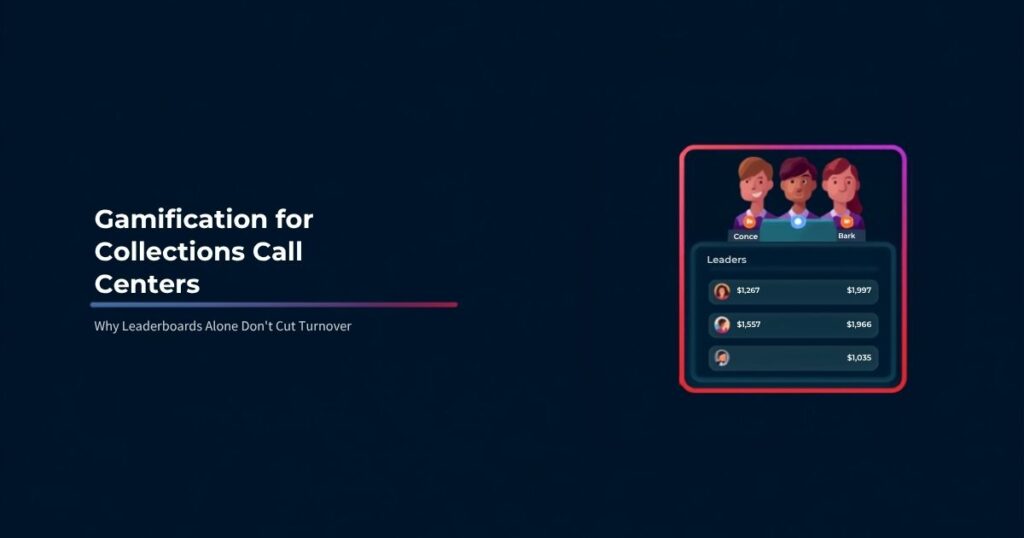
If you run a collections floor, you already know the uncomfortable math on turnover: the Society for Human Resource Management estimates replacing a single employee costs between 50% and 200% of their annual salary. On a floor where most calls end in a no and agents work inside compliance guardrails they didn’t write, that number climbs fast. Search “gamification for collections call centers” and you’ll find the same promise everywhere: badges, points, a leaderboard, done. That promise doesn’t hold up on a real collections floor.
ZIZO isn’t a gamification platform. It’s a behavioral reinforcement system, and on a collections floor, that distinction is the whole point.
Where Generic Gamification Breaks on a Collections Floor
Collections work runs on repetition under pressure: right-party contacts, promises to pay, compliance scripts, call volume — all inside FDCPA and TCPA guardrails collectors didn’t write and can’t control. Layer a stack-ranked leaderboard on top of that, and you’re rewarding your top three collectors while reminding everyone else, all shift long, that they’re behind.
That’s not a recognition problem. It’s a design problem. Forced-ranking systems like this are well documented to demotivate the employees who don’t land in the top tier, even when those employees are working hard. Standard gamification tools track activity. They don’t reinforce the specific behaviors that actually move a collections floor: consistent dial pace, clean compliance adherence, and follow-through on promises to pay.
What’s the Difference Between Gamification and Behavioral Reinforcement?
Gamification means adding game mechanics — points, badges, leaderboards — on top of existing work. It’s a delivery mechanism, and on its own it doesn’t ask which behaviors actually deserve reinforcing. Behavioral reinforcement starts from the opposite direction: identify what a collector controls, reinforce it consistently and in the moment, and let the game mechanics serve that structure instead of standing in for it. ZIZO is built as the second thing. Gamification shows up inside it, but it isn’t the architecture.
The Five Pillars, Applied to a Collections Floor
ZIZO’s Engagement Architecture rests on five pillars. Here’s what each one looks like when the KPIs are right-party contacts, promise-to-pay rate, and dollars collected per hour instead of generic call-center metrics.
Performance Visibility
Every collector sees their own numbers — contacts, promises secured, compliance flags — in real time. Not in a report their supervisor pulls at the end of the week.
Recognition Velocity
A collector who hits a promise-to-pay milestone gets recognized in the moment, not at a monthly all-hands three weeks later when the win is cold. Timing matters here: Gallup’s research on workplace recognition found that well-recognized employees were 45% less likely to have left their job two years later, and delay is one of the fastest ways to drain the value out of a recognition moment.
Behavioral Controllability
ZIZO ties reinforcement to what a collector actually controls — call pace, script adherence, follow-up discipline. Not to whether a debtor pays, which no collector can control.
Reinforcement Density
Recognition happens often enough to matter across a full shift of rejection-heavy calls, not once a month.
Progressive Reinforcement Architecture
The system scales with a collector as they improve. So a six-month collector and a six-year collector are both working toward something that fits where they actually are.
Everybody Wins — Even on a Floor Built Around Rejection
Everybody Wins is the architecture underneath all five pillars: every collector who hits their own threshold earns, at the same time as everyone else who hits theirs. Nobody’s win comes at a teammate’s expense.
On a floor where most calls end in a no, that distinction matters more than it does almost anywhere else in the contact center. A stack-ranked leaderboard tells eight out of ten collectors they lost today. ZIZO tells each collector whether they hit their own number — a much smaller, much fairer question.
Built for First-Party and Third-Party Collections
ZIZO works for in-house collections teams and third-party ARM agencies alike. Whether your collectors sit inside a bank’s recovery unit or on a dedicated agency floor working placements for multiple clients, the same architecture applies: visibility into the KPIs that matter, recognition tied to controllable behavior, and a compliance-safe structure that never rewards a collector for cutting corners.
“ZIZO makes it easy to see the ups and downs of collection days and to help pinpoint any trends that may need to be addressed. It really helps to motivate the team and keep them focused on performance.” — Director of Operations, Collections Agency Call Center
What This Looks Like on Your Floor
Instead of a leaderboard bolted onto your dialer, your supervisors get a live view of who’s on pace and who needs a coaching nudge before end of shift — not after. Your collectors get recognized for the calls they’re actually making well, in the moment those calls happen. None of it depends on whether today’s debtors happen to pay.
This is the same architecture behind ZIZO’s approach to call center performance management software — applied to a floor where the stakes, and the rejection rate, are higher.
Frequently Asked Questions
Is gamification effective for debt collectors?
Generic gamification — points and leaderboards with no underlying structure — tends to reward a small top tier and disengage everyone else. What works on a collections floor is reinforcement tied to controllable behavior, delivered often enough to matter.
How is ZIZO different from a collections leaderboard tool?
ZIZO reinforces behavior collectors control — call pace, compliance adherence, follow-through — instead of ranking them on outcomes like whether a debtor pays. Every collector who hits their own threshold earns, rather than competing for a fixed number of top spots.
Does ZIZO work for third-party collection agencies as well as in-house teams?
Yes. ZIZO fits both first-party collections teams inside a lender or servicer and third-party ARM agencies managing placements across multiple clients.
If you’re ready to see a live demo of ZIZO in action, go to the Schedule a Demo page and fill out the form. Go to the Blog main page for more articles, or check out the Resources section to read White Papers and Case Studies.
Solve your productivity, retention, and engagement challenges with ZIZO.
If you know someone who’d enjoy reading this page, share it with them via email, LinkedIn, Twitter/X, or Facebook. Get the latest updates delivered directly to your inbox.
Related: Call Center Performance Management Software · How to Reduce Call Center Attrition: 9 Proven Strategies