
Most call center leaders already know that engaged employees stick around longer. That part isn’t news. But what often gets overlooked is just how far the advantages of employee engagement actually reach, well beyond retention and into profitability, customer satisfaction, and even the day-to-day sanity of your management team.
The problem? Knowing engagement matters and actually building it are two very different things. Let’s break down the real, measurable advantages of employee engagement, why traditional approaches fall short, and what it takes to move the needle in a meaningful way.
What Does Employee Engagement Actually Look Like?
Before we talk about the advantages, it helps to get specific about what we mean. Employee engagement isn’t just about whether someone shows up and does their job. It’s about whether they care about the outcome. Engaged employees feel connected to the work they do, to the people around them, and to the goals of the organization.
That connection shows up in how they handle tough calls, whether they help a teammate who’s struggling, and how long they stay before they start looking elsewhere. It’s not about being happy all the time. It’s about being invested.
And here’s the thing: according to Gallup, only 23% of employees strongly agree that they get the right amount of recognition for the work they do. Those who do feel recognized? They’re five times more likely to be engaged. That gap between what people need and what they’re getting is where most of the opportunity lives.
Higher Productivity That Actually Shows Up in the Numbers
One of the clearest advantages of employee engagement is the direct impact on output. We’re not talking about vague “good vibes.” Gallup’s research found that highly engaged teams see 18% higher productivity in sales and 14% higher productivity across other production KPIs compared to teams in the bottom quartile of engagement.
Think about what that means in a call center environment. If you have 200 agents and engagement lifts productivity by even 15%, you’re looking at the equivalent output of 30 additional agents without adding a single seat. That’s not a soft metric. That’s real money.
And the reason is straightforward. When people understand what’s expected of them, get timely feedback on how they’re performing, and feel recognized for their effort, they naturally work harder and smarter. Research from SHRM backs this up, showing that employees who receive clear, actionable feedback are 42% more engaged in their work.
The challenge for most organizations is delivering that kind of feedback consistently, especially at scale. That’s where employee engagement tools built on behavioral science come in. Instead of relying on managers to catch every coaching moment, real-time systems can close the feedback loop automatically, giving employees the direction they need right when it matters.
Lower Turnover (and the Hidden Costs It Eliminates)
Turnover is the metric that keeps operations leaders up at night, and for good reason. In high-turnover call center environments, the cost of replacing a single agent can run anywhere from $3,000 to $15,000 when you factor in recruiting, onboarding, training, and the productivity ramp. Multiply that across a center losing 40% or more of its workforce annually, and you’re looking at a staggering drain on resources.
The advantages of employee engagement here are significant. Gallup’s data shows that high-turnover organizations with engaged workforces experience 21% less turnover. For low-turnover organizations, the difference is even more dramatic at 51% less turnover.
Companies with strategic recognition programs see a 31% lower voluntary turnover rate than those without, according to Quantum Workplace. And Harvard Business Review found that 69% of employees are more likely to stay with a company for three or more years when gamification is integrated into the workplace.
But here’s what the turnover numbers don’t fully capture: the institutional knowledge that walks out the door, the dip in team morale when someone leaves, and the burden on managers who are constantly onboarding new hires instead of coaching their existing team. Effective workforce retention strategies address the root cause of attrition, which is almost always disengagement, rather than just treating the symptoms.
Stronger Customer Outcomes
There’s a direct line between how your employees feel and how your customers are treated. It makes sense when you think about it. An agent who feels supported, recognized, and clear on their goals is going to bring more patience and energy to a difficult call than someone who feels invisible.
Gallup’s research found that engaged teams produce 10% higher customer loyalty and engagement. In industries like collections, insurance, and financial services where every customer interaction carries weight, that kind of lift can translate into meaningful revenue.
The connection works both ways, too. When employees see that their work leads to better customer outcomes, it reinforces their sense of purpose. It creates a feedback loop where good work leads to recognition, recognition fuels motivation, and motivation drives even better work. This is the behavioral science principle of positive reinforcement in action, and it’s one of the reasons why platforms built on these frameworks tend to outperform traditional management approaches.
Reduced Absenteeism and Presenteeism
Absenteeism gets a lot of attention, and it should. Gallup found that engaged workforces experience 78% lower absenteeism compared to disengaged ones. That’s a massive difference that directly affects scheduling, coverage, and service levels.
But presenteeism is the quieter problem that often does more damage. Presenteeism is when employees show up physically but aren’t really there mentally. They’re going through the motions, hitting minimum standards, and watching the clock. According to Harvard Business Review, the combined cost of absenteeism, presenteeism, and turnover adds up to roughly $12,000 in productivity loss per highly stressed employee per year.
The advantages of employee engagement in addressing both problems come down to how people feel about their work. When employees are genuinely engaged, they don’t just show up more often. They show up ready to contribute. They take more initiative (85% more, according to Zippia Research) and they’re more likely to push through challenges rather than disengage when things get tough.
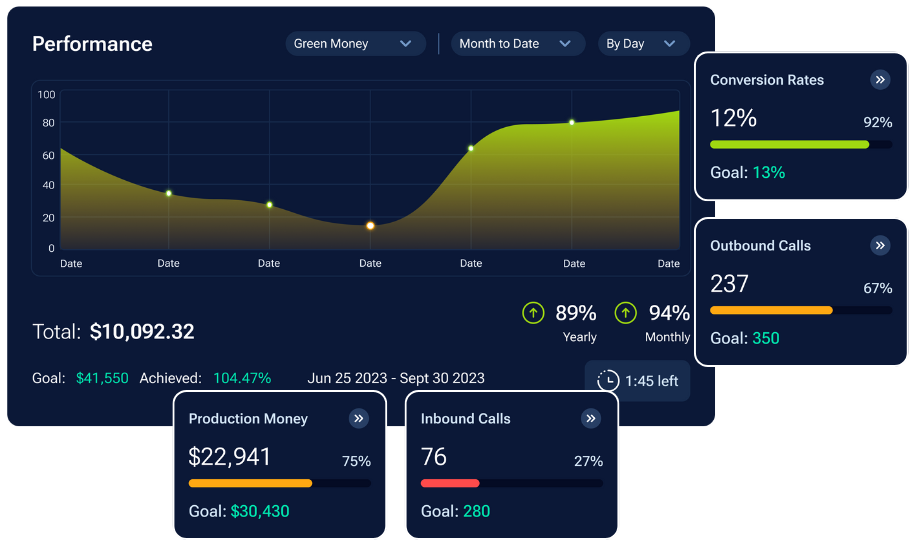
An employee performance dashboard that gives managers visibility into these patterns in real time can help identify disengagement before it turns into absenteeism or quiet quitting. The key is catching the signal early rather than reacting after the damage is done.
Better Profitability and Business Performance
If the advantages above sound like they should add up to better financial performance, that’s because they do. Gallup’s meta-analysis found that companies in the top quartile of employee engagement see 23% higher profitability than those in the bottom quartile.
McKinsey takes it further, noting that companies focused on people performance are 4.2 times more likely to outperform their peers, with an average of 30% higher revenue growth. On the flip side, Gallup estimates that disengaged employees cost their company the equivalent of 18% of their annual salary in lost productivity.
These aren’t small numbers. For a call center with 500 agents averaging $35,000 in annual salary, that disengagement tax could represent millions of dollars in unrealized value every year.
The math makes a compelling case for treating employee engagement not as an HR initiative, but as a core business strategy. And the organizations seeing the best results are the ones using employee engagement strategies grounded in behavioral science rather than gut instinct or annual surveys that arrive too late to be useful.

How to Actually Capture These Advantages
Knowing the advantages of employee engagement is the easy part. The harder question is how to build and sustain it, especially in fast-paced, high-pressure environments where managers are already stretched thin.
Here’s what the research tells us works:
Frequent, meaningful feedback. Employees are 3.6 times more likely to be motivated to do outstanding work when their manager provides daily feedback versus annual feedback, according to Gallup. And 80% of employees who received meaningful feedback in the past week report being fully engaged. The shift from annual reviews to real-time coaching is one of the highest-leverage changes an organization can make.
Recognition that feels earned and consistent. When employees believe they’ll be recognized for good work, they’re 2.7 times more likely to be highly engaged (Quantum Workplace). But only 27% of employees say they’ve received recognition or praise in the last seven days (Gallup). Closing that gap requires systems that make recognition automatic and data-driven rather than dependent on whether a manager happens to notice.
Gamification tied to real outcomes. This isn’t about making work “fun” for the sake of it. It’s about using the same dopamine-driven reward pathways that make games compelling and applying them to performance goals. An employee gamification platform that connects achievements to measurable KPIs creates a cycle of motivation that sustains itself over time.
Scalable management tools. In most call centers, the manager-to-agent ratio makes it impossible to provide individualized coaching at scale. One manager simply cannot meaningfully connect with 100 or 200 agents every day. Technology that delivers intelligent nudges, automated coaching prompts, and team-level insights allows managers to focus their time where it matters most.
Companies that invest in regular employee feedback see 14.9% lower turnover rates (Zippia Research), and feedback-focused organizations are 1.3 times more likely to outperform competitors in both talent retention and innovation (McKinsey). The pattern is consistent: when you build systems that deliver the right feedback, recognition, and motivation at the right time, engagement follows.
The Bottom Line
The advantages of employee engagement aren’t theoretical. They show up in lower turnover, higher productivity, stronger customer outcomes, reduced absenteeism, and better profitability. The research from Gallup, McKinsey, Harvard Business Review, and others points overwhelmingly in the same direction: engaged workforces outperform disengaged ones on virtually every metric that matters.
The question isn’t whether engagement is worth investing in. It’s whether your current approach is actually working, or whether you’re leaving those advantages on the table.
If you’re ready to see what a behavioral science-driven approach to engagement looks like in practice, schedule a demo and see how employee gamification software is helping call centers turn disengaged teams into high-performing ones.