
Employee engagement just hit an 11-year low. If you’re managing a call center, you already know this-you’re living it. High turnover, burned-out managers, agents who clock in but mentally check out. The usual motivational tactics aren’t cutting it anymore.
So companies turn to gamification. Points! Badges! Leaderboards! And then… crickets. Or worse, resentment. Because slapping a point system on boring work doesn’t magically make it engaging.
Here’s what actually works: gamification built on behavioral science, not just borrowed from video games. The kind that understands why humans do what they do, then uses that knowledge to create systems people actually want to participate in.
What Is Gamification in the Workplace?
Strip away the buzzword, and gamification is pretty straightforward-you’re applying game design principles to work environments to boost engagement and performance. But there’s a massive gap between doing this well and doing it poorly.
Bad gamification? That’s a leaderboard that makes 90% of your team feel like losers, or a badge system nobody cares about after week two. Good employee gamification software? That’s leveraging decades of psychological research to tap into what actually motivates people: autonomy, mastery, progress, and connection.
The platforms that work don’t just make work “fun” (whatever that means). They make progress visible, achievements meaningful, and growth actually attainable. That’s when employee engagement tools stop being something HR pushes and start being something your team actively uses.
The Business Case: Why Gamification Matters Now
Let’s talk money. Disengaged employees cost your company roughly 18% of their salary, according to Gallup. If you’re running a 200-person call center at $40K per employee, that’s over $1.4 million in lost productivity. Annually. Just from people showing up without actually being present.
And that’s before you factor in turnover costs-recruiting, hiring, training, the productivity hit while new agents ramp up. In high-turnover environments, you’re basically running on a treadmill, constantly replacing people instead of developing the team you have.
The research on what works is pretty clear:
On engagement and keeping people around:
- Companies with actual recognition programs (not just an “Employee of the Month” plaque) see 31% lower turnover
- 69% of employees say they’d stick around for 3+ years when gamification is done right
- People who expect to be recognized? They’re 2.7 times more likely to be engaged. Turns out humans like knowing their work matters.
On performance that moves the needle:
- Organizations focused on real-time performance management cut attrition by five percentage points
- Highly engaged teams show 21% higher profitability and 18% better sales productivity (Gallup’s data, not ours)
- Regular feedback drops turnover by 14.9%
- Clear, actionable feedback makes people 42% more engaged
If you’re leading operations in collections, financial services, insurance, or retail call centers, these aren’t abstract statistics. This is the difference between bleeding money on recruitment or actually building something. The right employee gamification platform doesn’t just make people happier-it fundamentally changes your unit economics.

The Behavioral Science Behind Effective Gamification
Here’s where most gamification falls apart-companies copy the surface-level stuff (points, badges, leaderboards) without understanding the psychology underneath. It’s like trying to bake bread because you saw a picture of a loaf. You need to know what makes it rise.
Operant Conditioning and Positive Reinforcement
B.F. Skinner figured this out decades ago: behaviors that get rewarded get repeated. Pretty simple. But here’s what matters-timing.
Telling someone “good job” three weeks after they did something great? Useless. Their brain has moved on. But catch that moment right when it happens? That’s when you’re actually wiring in the behavior you want.
80% of employees who got meaningful feedback in the past week are fully engaged. The other 20%? Probably waiting on their quarterly review to find out how they’re doing.
This is why the best employee engagement strategies happen in real-time. When a call center agent handles a nightmare customer interaction with grace, and they get recognized immediately-not in next month’s team meeting-that’s when behavioral change actually sticks.
Self-Determination Theory: What Actually Drives People
Psychologists Deci and Ryan spent years figuring out what makes people tick. Turns out, we’ve got three core needs:
- Autonomy – We want some control over our work, not to be micromanaged robots
- Competence – We want to get better at things, to feel like we’re growing
- Relatedness – We want to connect with other humans, not work in isolation
And here’s what the data shows: employees are 3.6 times more motivated when they get daily feedback instead of waiting for an annual review. That’s not surprising-daily feedback supports both competence (you’re learning continuously) and autonomy (you have the info you need to adjust without someone hovering).
Most gamification crashes and burns because it’s all extrinsic motivation-do this, get that. Badges and leaderboards might work for a week, maybe two. But without supporting those deeper psychological needs, people check out fast.
Goal-Setting Theory and Progressive Challenges
Edwin Locke proved that specific, challenging goals beat vague ones every time. “Do your best” doesn’t work. “Increase your first-call resolution rate from 73% to 78% this month” does.
But-and this is crucial-the goal has to feel achievable. Set the bar impossibly high, and people won’t even try. It’s like putting a beginner on the hardest level of a video game. They’re not learning; they’re rage-quitting.
The smartest employee performance dashboard systems adapt difficulty based on where someone actually is. Your top performers get stretch goals that keep them engaged. Your developing team members get targets that build confidence and skill. Everyone’s challenged at their level.
Dopamine and Why Anticipation Matters
Quick neuroscience lesson: dopamine isn’t actually the “pleasure chemical.” It’s the anticipation chemical. Your brain releases it when you’re expecting a reward, not just when you get one.
This creates powerful behavioral loops. The possibility of recognition drives sustained effort-you keep going because something good might be around the corner.
81% of employees who received recognition said they’d work harder (Glassdoor study). But the frequency matters. Predictable rewards lose power fast. Variable rewards-where you don’t know exactly when recognition is coming, just that it will-create the strongest engagement. It’s the same psychology behind why slot machines are so compelling.
Don’t worry, we’re not suggesting you turn your workplace into a casino. But understanding these patterns helps you design systems that maintain motivation over time, not just create a brief spike of interest.
Real-Time Performance Intelligence: Moving Beyond Spreadsheets
Let’s be honest about traditional performance management-it’s archaeology. You’re excavating data from weeks or months ago, trying to piece together what happened, then having “coaching conversations” about problems that are long past fixing.
Monthly reports. Quarterly reviews. By the time you identify that an agent is struggling with objection handling, they’ve already bombed hundreds of calls. The moment when coaching would’ve actually helped? That was three weeks ago.
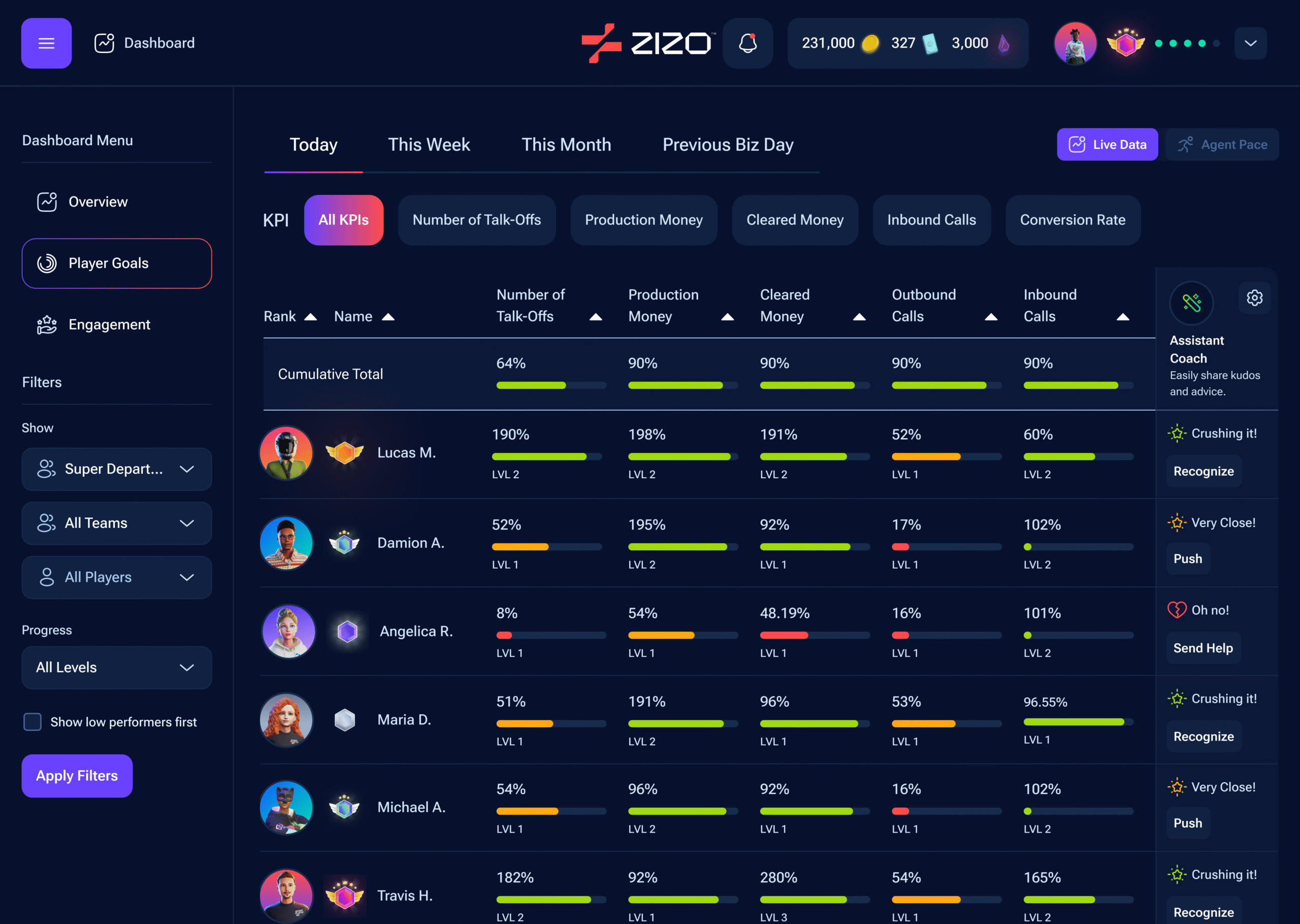
This is why real-time performance intelligence isn’t just nice to have-it’s the whole point. When you can see performance issues as they’re happening, you can actually do something about them. Agent struggling on a difficult call? Manager gets an alert and can jump in with support or queue up a coaching conversation for right after.
McKinsey found that feedback-focused companies outperform competitors by 1.3 times in both retention and innovation. But the differentiator isn’t just giving feedback-it’s giving the right feedback, at the right time, with the right level of specificity.
And here’s the scalability piece that matters: traditionally, a manager can effectively coach maybe 20-30 agents. That’s about the limit of human attention and time. But with intelligent systems that flag coaching opportunities, send automated nudges, and surface live performance data, one manager can support 200 agents with the same personalized attention.
Not because they’re superhuman. Because they’re not wasting time pulling reports and can focus entirely on the high-value work of actual coaching.
Inclusive Gamification: Avoiding the Pitfalls
Gamification can absolutely backfire. We’ve all seen it-systems that create more problems than they solve.
Over-Emphasis on Competition
Here’s a fun fact from player research: only about 10% of people are primarily motivated by competition and achievement. The other 90%? They’re driven more by social connection, cooperation, exploration, or just wanting to do good work.
Yet most workplace gamification is basically one big leaderboard. Which means you’re designing for the 10% and actively demotivating everyone else. The top performers love it. The middle 80% of your team feels like they’re losing every single day. That’s not engagement; that’s learned helplessness.
Worse, excessive competition kills collaboration. Why would I help a colleague if it might push them ahead of me on the leaderboard? You end up with people hoarding knowledge, refusing to help teammates, and gaming the system in ways that hurt actual business outcomes.
Rewards Undermining Ethics
When points and prizes become the focus, people optimize for the metric, not the mission. In call centers, this shows up as agents racing through calls to hit volume targets while customer satisfaction tanks. Or in sales, closing deals that shouldn’t be closed just to hit a number.
If your gamification system rewards quantity over quality, don’t be surprised when people prioritize quantity over quality. Humans are excellent at figuring out what you’re actually measuring and giving you exactly that-even if it’s not what you really wanted.
The systems that work measure the behaviors that actually drive business value: quality conversations, problem resolution, customer satisfaction, compliance. Not just easily gameable metrics like call volume.
Algorithmic Fairness and Transparency
People need to trust the system. If recognition feels arbitrary or biased, the whole thing falls apart. Employees need to understand how decisions are made and believe they’re being treated fairly.
This is especially tricky with algorithm-based recognition. The math might be perfectly objective, but if it feels like it favors certain people or working styles, you’ve got a problem. Good systems are transparent about what’s being measured and why. They’re designed to catch genuine performance improvement, not just reward people who happen to fit a certain profile.
Practical Implementation: What Works in High-Pressure Environments
Enough theory. Let’s talk about what actually works when you’re managing a high-turnover call center and need results, not academic papers.
Start with Clear, Measurable Goals
Pick 3-5 KPIs that genuinely drive your business. Not every metric that exists-the ones that actually matter. For most call centers, this looks like:
- First call resolution rate (are we fixing problems or passing them along?)
- Average handle time balanced with quality (fast and good, not just fast)
- Customer satisfaction scores (do customers actually like talking to us?)
- Compliance and adherence (are we following the rules?)
- Sales conversion or collection rates (are we moving the needle?)
Your employee performance dashboard should make these crystal clear. Every agent should know exactly what they’re shooting for and where they stand. No mystery, no confusion.
Provide Immediate, Specific Feedback
“Good job” means nothing. It’s verbal wallpaper.
“Great work using the customer’s name three times during that call. Personalization increased your quality score by 12% this week and helps build rapport that drives satisfaction”-that’s feedback.
85% of employees take more initiative when they get feedback. But it has to be specific and timely. Generic praise or criticism delivered weeks late doesn’t change behavior. It just creates frustration.
Create Multiple Paths to Recognition
Not everyone is motivated by the same things. Your competitive overachievers want to top the leaderboard. Your master craftspeople want to hit personal bests and develop new skills. Your social butterflies want peer recognition and team challenges.
Build different ways to win:
- Individual achievement badges for personal bests
- Team challenges that reward collaboration
- Skill development milestones that celebrate mastery
- Peer recognition that strengthens relationships
- Manager highlights for personalized attention
When you create multiple paths to success, you’re not just motivating your natural competitors-you’re engaging your entire team.
Scale Management Capabilities
Here’s the math problem: Your manager-to-agent ratio is probably somewhere around 1:20 or worse. Traditional coaching doesn’t scale at that ratio. There literally aren’t enough hours in the day.
But employee engagement tools that automate the routine stuff change the equation completely. The system flags who needs help, suggests specific coaching approaches based on patterns it’s seeing, and tracks improvement over time.
Your managers stop spending hours pulling reports and can focus entirely on coaching conversations. That’s how you get from managing 20 agents to effectively supporting 200.
Industry-Specific Applications
Different industries, different pressure points. Here’s how gamification plays out in various high-stakes environments:
Sales Organizations
Monthly quotas are overwhelming. They’re this massive number looming in the distance that either feels impossible or so far off it doesn’t create urgency.
Sales gamification software breaks that down into daily and weekly challenges that maintain momentum. Instead of “close $100K this month” (which is paralyzing on day 2), you’re celebrating daily activity wins, pipeline development, and incremental progress.
And here’s a smart move: track “most improved” alongside top performers. When the leaderboard only celebrates your natural closers, the rest of your team learns to ignore it. But when you’re recognizing people moving up the rankings-the rep who went from 60% to 75% of quota-suddenly everyone’s paying attention because everyone has a shot.
Collections and Financial Services
Collections is emotionally brutal work. You’re calling people who don’t want to hear from you, dealing with hostility and stress, and the rejection rate would break most people.
Gamification in this environment isn’t about making it “fun”-it’s about making difficult work feel achievable and valued. Recognition for handling tough conversations professionally, maintaining promise-to-pay rates, hitting quality scores. You’re acknowledging that this work is hard and that doing it well matters.
Customer Service and Support Centers
Quality metrics, first-call resolution, customer satisfaction scores, knowledge base utilization-these are the differentiators between support centers that are cost centers and ones that drive loyalty.
Gamify the stuff that matters: agents who consistently solve complex problems, people who get positive customer shoutouts, teams that improve their CSAT scores month over month. You’re reinforcing behaviors that create long-term customer relationships, not just fast handle times.

Measuring ROI: Proving Gamification’s Value
CFOs don’t care about engagement scores. They care about whether this investment makes money or saves money. Fair enough.
Here’s what to track:
Turnover and Retention: The big one. Calculate your cost per hire (recruiting, interviewing, onboarding, training, the productivity loss during ramp-up). Then track:
- Voluntary attrition rate before and after
- How much you’re spending on recruitment
- Time to productivity for new hires
- Retention of your top performers specifically (losing B players hurts; losing A players kills you)
Companies focused on performance management see attrition drop by five percentage points. McKinsey found they’re also 4.2 times more likely to outperform peers, with 30% higher revenue growth. That’s not incremental improvement-that’s game-changing.
Productivity Metrics: What actually moves the business?
- Sales per agent or collections per hour
- Handle time improvements that don’t sacrifice quality
- Schedule adherence and attendance (people actually showing up)
- Quality scores across the team
Engaged teams deliver 18% higher sales productivity and 14% better performance on other production KPIs. Every percentage point here drops straight to your bottom line.
Employee Engagement Indicators: These are leading indicators of the numbers above:
- Participation rates in your gamification system (are people actually using it?)
- Internal promotion rates (are you developing people or just churning through them?)
- Employee satisfaction survey results
- Manager-to-agent ratios (can you scale without adding headcount?)
When people get accurate, consistent feedback, 68% say they feel fulfilled at work. That’s not a soft metric-fulfillment predicts retention and performance.
The Future of Workforce Performance Management
Performance management is going through the same shift that happened with customer feedback. Remember when companies collected feedback through annual surveys, compiled it into binders, and made decisions based on year-old data? Then real-time customer feedback became possible, and suddenly companies could actually respond to what customers were saying now, not what they said months ago.
That’s where workforce performance is headed. The companies winning the talent war aren’t the ones with the best quarterly review process. They’re the ones who’ve invested in employee engagement strategies that work in real-time, backed by actual psychological research, delivered through systems that scale.
As work gets more distributed, teams get more diverse (four generations working together now), and competition for skilled workers intensifies, the gap between companies with modern performance systems and those still running on spreadsheets is only going to widen.
The question isn’t whether gamification works-decades of research and thousands of implementations prove it does. The real question is whether you’re going to implement it thoughtfully (with behavioral science, fair algorithms, and measurable outcomes) or settle for surface-level point systems that fail in six months.
Getting Started: From Strategy to Implementation
If you’re ready to move past spreadsheet management and actually transform how your team performs, here’s the playbook:
- Assessment – Figure out where you are now. Current engagement levels, turnover rates, the performance metrics that actually matter to your P&L. You need a baseline to measure against.
- Goal Setting – Get specific about what you’re trying to accomplish. “Better engagement” isn’t a goal. “Reduce voluntary attrition from 40% to 32% in Q2” is a goal. “Increase average quality scores from 78% to 85%” is a goal. Tie everything to business KPIs.
- Platform Selection – Choose hr performance management software that’s built on behavioral science, not just borrowed game mechanics. Look for systems that adapt to different motivational drivers, provide real-time feedback, and scale management capabilities.
- Pilot Program – Don’t roll this out to 1,000 agents on day one. Start with a subset of teams. Test, learn, refine. Figure out what works in your environment before you scale.
- Manager Training – Your frontline managers need to understand how to use real-time data and coaching opportunities effectively. If they just treat it like another dashboard to ignore, you’ve wasted everyone’s time.
- Continuous Optimization – This isn’t set-it-and-forget-it. Monitor engagement metrics and business outcomes. Gather feedback from agents and managers. Keep improving the experience.
- Scale Success – Once you’ve proven the approach works, expand it. But keep focused on what actually drives behavioral change, not just what looks good in a demo.
Conclusion: Science, Not Spreadsheets
Here’s the core insight from all that behavioral science research: people aren’t motivated by badges and points. They’re motivated by purpose, progress, mastery, and connection.
Good gamification doesn’t replace intrinsic motivation with cheap rewards. It amplifies intrinsic motivation by making progress visible, achievements meaningful, and growth actually attainable.
For operations leaders managing high-pressure, high-turnover environments, the math is simple. Every percentage point of turnover you prevent saves thousands in recruitment and training costs. Every productivity improvement flows straight to the bottom line. Every engaged employee who grows with your organization compounds value over time.
You can’t afford to guess at this anymore. Not when disengagement is costing you 18% of every salary. Not when your competitors are implementing systems that actually work.
The difference between gamification that transforms performance and gamification that dies in six months comes down to foundation. Validated behavioral science. Real-time intelligence. Inclusive design. Relentless focus on outcomes that matter.
Ready to see what this looks like in practice? Schedule a demo and we’ll show you how the right employee gamification platform delivers measurable improvements in productivity, engagement, and retention-usually within 90 days.
Not because we’re promising magic. Because we’re applying science.
Want more insights on transforming workforce performance? Check out our resources on employee engagement strategies and hr performance management software built for high-pressure call center environments.